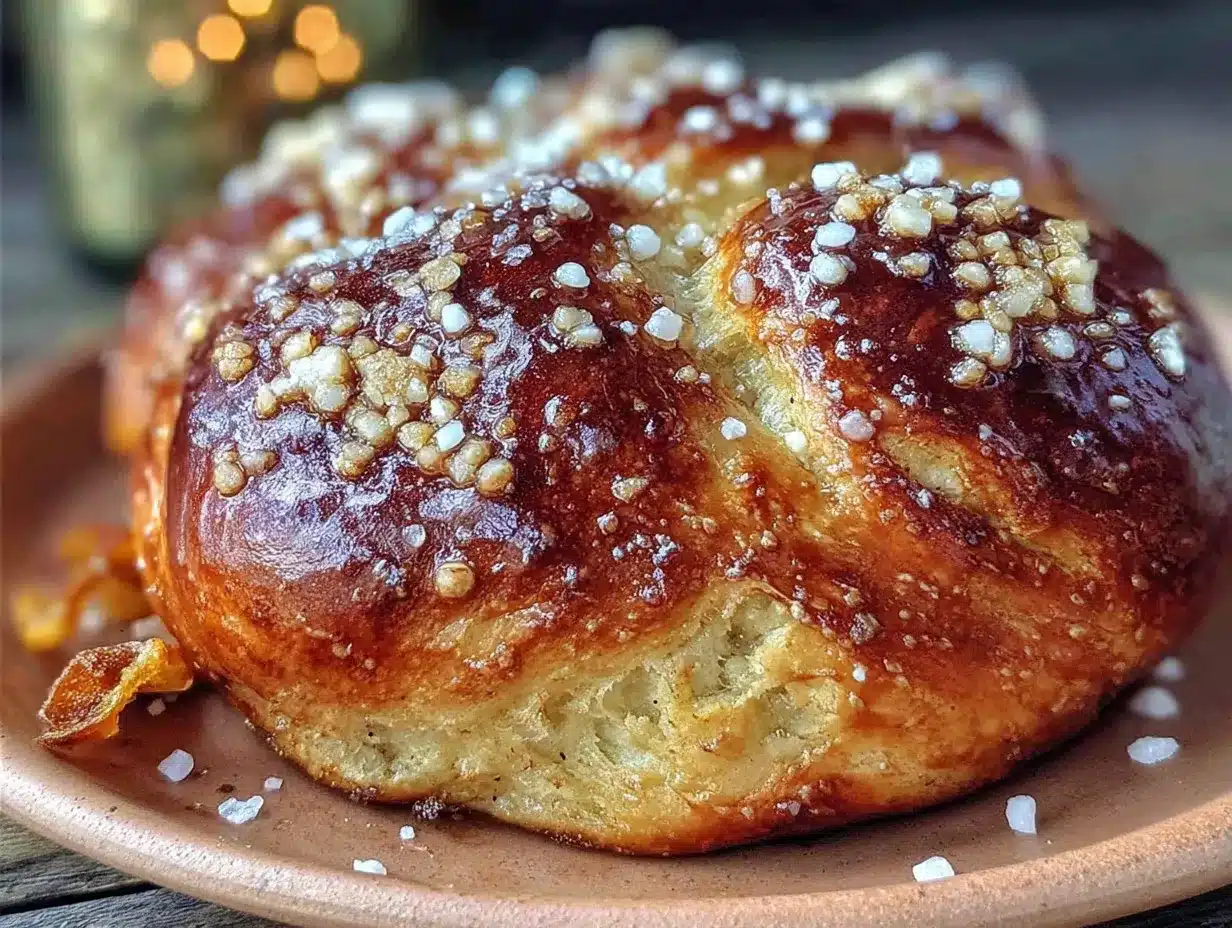
My neighbor, Doña Elena, didn’t say a word when she handed me the plate. She just pointed at the bread, then at the altar she’d built in her living room. The Pan de Muerto was still warm, dusted with sugar that sparkled under her candlelight. I took a bite and honestly, I almost cried. It wasn’t just bread—it was a conversation with someone I’d never met, baked into something soft and fragrant.
I’d been trying to perfect a Pan de Muerto recipe for years before that moment. The ones I found online were either too dry, too sweet, or missing that unmistakable floral whisper that makes this bread so special. Doña Elena’s version had it all—a pillowy crumb, a hint of orange, and that delicate crunch of orange blossom sugar on top. She finally shared her secrets with me, and I’ve been making it every November since.
This isn’t one of those fussy breads that requires a million steps. It’s actually forgiving in a way that surprised me. The dough comes together in a stand mixer, rises while you clean the kitchen, and fills your whole house with the kind of smell that makes neighbors stop by unannounced. I’ve learned that the key is patience with the yeast and trust in the process. The first time I made it, I was nervous about the shaping—those little bone-shaped decorations felt intimidating. But after a few tries, I realized the dough tells you what to do if you just listen to it.
This Pan de Muerto has become my way of honoring the people I’ve lost. It’s a small ritual, a quiet moment of connection. And honestly, any bread that makes you feel that way is worth baking.
Why You’ll Love This Recipe
I’ve tested this Pan de Muerto recipe more times than I can count, tweaking the hydration, adjusting the proofing times, and swapping different types of orange blossom water. What I landed on is a version that balances tradition with reliability—something that works whether you’re a seasoned baker or someone who’s never worked with yeast before.
- Authentic Flavor: This uses real orange blossom water and fresh orange zest, not artificial extracts. The difference is night and day. You get that delicate floral note that sits right behind the citrus, never overpowering it.
- Foolproof Dough: The hydration level is dialed in so the dough is soft but not sticky. It rises beautifully even in cooler kitchens, and it’s forgiving if you need to step away for an hour.
- Simple Ingredients: Flour, butter, eggs, sugar, yeast, orange blossom water, and salt. That’s it. No weird stabilizers or hard-to-find items (except maybe the orange blossom water, which you can find at any Latin grocery or online).
- Perfect for Día de Muertos: This bread is the centerpiece of any ofrenda. It’s meant to be shared, eaten with hot chocolate or coffee, and enjoyed with family. But honestly, it’s too good to make only once a year.
- Freezes Beautifully: I always make a double batch. One loaf goes on the altar, the other gets wrapped and frozen for those random Tuesday cravings when you need a taste of something meaningful.
What makes this Pan de Muerto different from others I’ve tried is the texture. It’s not quite brioche—it’s lighter, almost airy, with a crumb that tears instead of slices cleanly. The orange blossom sugar on top isn’t just decoration; it adds a subtle crunch and a burst of fragrance that hits you with every bite. I’ve had friends tell me it reminds them of their grandmother’s version, which is the highest compliment I could ever receive.
This recipe is the one I turn to when I want to feel connected to something bigger than myself. It’s comfort food in the truest sense—not just filling, but soul-filling. And when you pull that golden loaf out of the oven, dusted with sugar and smelling like orange groves and memories, you’ll understand exactly what I mean.
What Ingredients You Will Need
This Pan de Muerto recipe relies on simple, wholesome ingredients that work together to create something truly special. Most of these are pantry staples, but a few deserve a bit of explanation so you get the best results.
- All-purpose flour (4 cups / 500g): I use King Arthur Flour for consistent protein content, but any brand works. Don’t use bread flour—it makes the bread too chewy. We want tender, not tough.
- Active dry yeast (2 ¼ teaspoons / 7g, or 1 packet): Make sure your yeast is fresh. I always proof it in warm water with a pinch of sugar first to make sure it’s alive. If it doesn’t foam up after 10 minutes, toss it and start over.
- Warm water (¼ cup / 60ml): About 105°F to 110°F. Too hot kills the yeast, too cold and it won’t activate. I use a thermometer, but if you don’t have one, the water should feel like a warm bath—comfortable on your wrist.
- Whole milk (½ cup / 120ml), warmed: Whole milk gives the richest flavor, but 2% works in a pinch. Don’t use skim—the fat is important for tenderness.
- Granulated sugar (½ cup / 100g): This isn’t an overly sweet bread. The sugar feeds the yeast and adds just enough sweetness to balance the floral notes.
- Unsalted butter (½ cup / 113g, or 1 stick), softened: Let it sit out for at least an hour. Cold butter won’t incorporate properly and you’ll end up with greasy dough.
- Large eggs (3, room temperature): Cold eggs will shock the dough and slow down rising. I set mine out with the butter so everything comes to room temperature together.
- Orange blossom water (2 tablespoons / 30ml): This is the star of the show. I recommend Cortas brand—it’s widely available and has a clean, authentic flavor. Don’t substitute rose water unless you’re making a completely different bread.
- Fresh orange zest (1 tablespoon, from about 1 large orange): Use a microplane, not a box grater. You want the fragrant outer layer, not the bitter white pith.
- Salt (1 teaspoon / 6g): Fine sea salt dissolves better than kosher salt in doughs.
For the orange blossom sugar topping:
- Granulated sugar (¼ cup / 50g)
- Orange blossom water (1 tablespoon / 15ml)
- Melted butter (2 tablespoons / 28g)
The orange blossom sugar is what sets this Pan de Muerto recipe apart. You mix the sugar with a tiny bit of orange blossom water and let it dry slightly before using. It creates these fragrant crystals that stay crunchy on top of the bread. I learned this trick from Doña Elena, and it makes all the difference. Store any extra in an airtight jar—it’s amazing on shortbread cookies or even stirred into coffee.
Equipment Needed
You don’t need a professional bakery setup for this Pan de Muerto recipe, but a few key tools make the process smoother.
- Stand mixer with dough hook: This is my preferred method because the dough is soft and needs about 10 minutes of kneading. A stand mixer does the work without heating the dough with your hands. If you don’t have one, kneading by hand works—it just takes longer (about 15-20 minutes) and requires more flour on the surface.
- Large mixing bowl: For the first rise. I use a glass bowl so I can see the dough doubling in size.
- Baking sheet (half-sheet pan): Line it with parchment paper. The bread spreads a bit during baking, so give it room.
- Pastry brush: For applying the melted butter and orange blossom water glaze after baking. A silicone brush works better than a natural bristle one for this.
- Microplane or fine zester: Essential for getting that fragrant orange zest without the bitter pith.
- Kitchen scale: I strongly recommend weighing your flour. Cup measurements can vary by as much as 30%, which affects the dough hydration. A scale costs about $15 and will improve every baked good you make.
- Plastic wrap or a clean kitchen towel: For covering the dough while it rises. I prefer a damp towel in dry climates—it prevents a skin from forming on the dough.
I’ve made this bread in a tiny apartment kitchen with a hand mixer and a lot of patience. It’s doable. But if you bake regularly, investing in a good stand mixer is worth every penny. My KitchenAid has been going strong for over a decade, and it’s made recipes like this Pan de Muerto feel approachable rather than intimidating.
Preparation Method
This Pan de Muerto recipe takes about 3 hours total, with most of that being inactive rising time. The actual hands-on work is maybe 30 minutes. Here’s how it breaks down.
- Proof the yeast (5 minutes): In a small bowl, combine the warm water, 1 teaspoon of sugar, and the yeast. Stir gently and let it sit for 5-10 minutes until it becomes foamy and smells like bread. If nothing happens, your yeast is dead. Start over with fresh yeast.
- Mix the dry ingredients (2 minutes): In the bowl of your stand mixer, whisk together the flour, remaining sugar, salt, and orange zest. This distributes the zest evenly so every bite has that citrus pop.
- Combine the wet ingredients (3 minutes): Add the proofed yeast mixture, warm milk, eggs, orange blossom water, and softened butter to the flour mixture. Use the paddle attachment on low speed to combine everything until a shaggy dough forms. It will look messy—that’s normal.
- Knead the dough (10 minutes): Switch to the dough hook and knead on medium-low speed for 8-10 minutes. The dough should pull away from the sides of the bowl and become smooth and elastic. It will be soft and slightly tacky but not sticky. If it’s too wet, add flour 1 tablespoon at a time. If it’s too dry, add milk 1 teaspoon at a time.
- First rise (1 to 1.5 hours): Transfer the dough to a lightly greased bowl, turning once to coat. Cover with plastic wrap or a damp towel and let it rise in a warm, draft-free spot until doubled in size. I put mine in the microwave (turned off) with a cup of hot water next to it. The steam and warmth speed things up.
- Shape the loaves (15 minutes): Punch down the dough to release the gas. Turn it out onto a lightly floured surface. Divide it into two equal pieces. Take one piece and cut off about ¼ of it. Roll the larger piece into a smooth ball and place it on your parchment-lined baking sheet. The smaller piece will become the bone decorations.
- Create the bones and top knot (10 minutes): Divide the smaller piece into 3 sections. Roll each into a rope about 6 inches long. Cut each rope into 2-inch pieces. For the “bones,” roll each piece into a small ball, then use your finger to press indentations on either side. Place four of these bone pieces around the top of the loaf in a cross pattern. For the top knot, roll the remaining dough into a small ball and place it in the center where the bones meet. Repeat with the second loaf.
- Second rise (45 minutes to 1 hour): Cover the shaped loaves loosely with plastic wrap and let them rise again until puffy and almost doubled. They should look like they’re about to burst with joy.
- Preheat the oven (15 minutes before baking): Set your oven to 350°F (175°C). Position a rack in the center.
- Bake (20-25 minutes): Bake the loaves until they’re deep golden brown on top and sound hollow when tapped on the bottom. An instant-read thermometer inserted into the center should read 190°F (88°C).
- Glaze and sugar (immediately after baking): While the bread is still warm, brush the tops with melted butter. Then brush with orange blossom water. Finally, generously sprinkle the orange blossom sugar over the top. The heat will make the sugar stick and create that beautiful crystalline crust.
- Cool completely (1 hour): Transfer to a wire rack and let cool completely before slicing. I know it’s tempting to tear into it warm, but the texture sets as it cools. If you can’t wait (I never can), at least let it rest for 20 minutes.
A few notes from my many trials: If your dough seems too sticky during kneading, resist the urge to add too much flour. A soft dough yields a tender crumb. Also, don’t skip the second rise—it’s what gives the bread that airy, almost cloud-like texture. I once rushed this step and ended up with dense, sad bread. Never again.
Cooking Tips & Techniques
After making this Pan de Muerto recipe at least two dozen times, I’ve collected a few hard-won lessons that will save you from my early mistakes.
Temperature matters more than you think. Cold ingredients will make your dough sluggish and dense. I learned this the hard way when I used cold eggs straight from the fridge and ended up with a dough that refused to rise for over two hours. Now I set everything out on the counter an hour before I start. The butter should be soft enough that you can press it with your finger and leave a dent.
The windowpane test is your friend. After kneading, pinch off a small piece of dough and stretch it gently between your fingers. If it stretches thin enough to see light through without tearing, it’s ready. If it tears, knead for another 2 minutes and test again. This is more reliable than timing alone.
Don’t overthink the shaping. The bone decorations are meant to look rustic. I’ve seen bakers spend 20 minutes perfecting each little bone, and honestly, the bread tastes the same. My first attempt looked like a kindergartner’s art project, but it was still delicious. The imperfections make it feel handmade and authentic.
Watch the oven like a hawk. Every oven runs differently. My old oven would brown the tops too quickly, so I started tenting the loaves with foil after 15 minutes. Check yours at 18 minutes and adjust accordingly. You want a deep golden brown, not burnt.
Let it cool properly. This is the hardest tip to follow. The bread continues to cook internally as it cools, and slicing too early will give you a gummy texture. I set a timer for 30 minutes and force myself to wait. The reward is a perfect crumb that holds together beautifully.
Variations & Adaptations
This Pan de Muerto recipe is traditional at its core, but I’ve experimented with a few twists that honor the spirit while adding something new.
Chocolate Pan de Muerto: Add ¼ cup of unsweetened cocoa powder to the flour mixture and increase the sugar by 2 tablespoons. The chocolate pairs beautifully with the orange blossom. I made this for a friend who doesn’t love floral flavors, and she ate half the loaf in one sitting.
Gluten-free version: Use a 1:1 gluten-free baking flour blend that contains xanthan gum. The dough will be stickier and harder to shape, so I recommend using a wet spatula and slightly oiled hands. The texture won’t be exactly the same—it’s a bit more cake-like—but the flavor is still fantastic.
Vegan adaptation: Substitute the butter with vegan butter (I like Miyoko’s), use flax eggs (1 tablespoon ground flaxseed + 3 tablespoons water per egg), and swap the milk for oat milk. The bread will be slightly denser but still delicious. Brush with melted vegan butter after baking.
Orange extract shortcut: If you can’t find orange blossom water, you can use 1 teaspoon of orange extract mixed with 1 tablespoon of water. It won’t have the same floral depth, but it’s better than skipping it entirely. I’ve also used orange liqueur like Grand Marnier in a pinch—just reduce the liquid slightly.
Individual rolls: Instead of shaping two large loaves, divide the dough into 12 equal pieces and shape into balls. Skip the bone decorations. Bake for 15-18 minutes. These are perfect for sharing at parties or freezing for later. I’ve brought them to potlucks and they disappear faster than anything else on the table.
Serving & Storage Suggestions
Pan de Muerto is traditionally served alongside a cup of hot chocolate or café de olla (Mexican spiced coffee). The bitterness of the chocolate balances the sweet, floral bread perfectly. I also love it with a simple cup of black tea or horchata.
Serve it at room temperature, torn into pieces rather than sliced. The rustic presentation feels more authentic. If you’re setting it on an ofrenda, place it on a plate with marigolds and a photo of your loved one. The bread is meant to be shared—break off pieces and pass them around.
Storage: Keep the bread in an airtight container at room temperature for up to 3 days. Do not refrigerate—it will dry out and become stale. The orange blossom sugar may soften over time, but the flavor will still be wonderful.
Freezing: This bread freezes exceptionally well. Wrap the cooled loaf tightly in plastic wrap, then in aluminum foil. Freeze for up to 3 months. To thaw, leave it at room temperature for 4 hours, then warm in a 300°F oven for 10 minutes. The crust will crisp up and the interior will be just as tender as the day you baked it.
Reheating: If the bread has gone a bit stale, don’t toss it. Slice it thick and toast it lightly, then spread with butter and a drizzle of honey. The orange blossom flavor intensifies with heat, and the toastiness adds a new dimension. I’ve also used day-old Pan de Muerto in a bread pudding with incredible results—the floral notes infuse the custard beautifully.
Nutritional Information & Benefits
This Pan de Muerto recipe is a treat, not a health food, but it does offer some surprising benefits. Here’s the approximate nutritional breakdown per serving (1/12th of a loaf):
- Calories: 285
- Fat: 12g
- Carbohydrates: 38g
- Protein: 6g
- Fiber: 1g
- Sugar: 14g
The orange blossom water isn’t just for flavor—it has mild calming properties and has been used in traditional medicine to reduce anxiety. The eggs provide high-quality protein and choline, which supports brain health. And the butter… well, butter makes everything better, and it’s a source of fat-soluble vitamins A, D, E, and K.
If you’re watching your sugar intake, you can reduce the orange blossom sugar topping by half or skip it entirely. The bread itself isn’t overly sweet, and the orange blossom water still provides plenty of flavor. For a lower-calorie option, use a butter substitute and reduce the eggs to 2.
This bread is not gluten-free or dairy-free in its traditional form, but the variations I shared above can accommodate most dietary needs. Always check your ingredients for potential allergens—some orange blossom waters contain additives.
Conclusion
This Pan de Muerto recipe has become a November tradition in my home, but I’ve found myself making it year-round whenever I need a reminder of what matters. There’s something about the act of baking—measuring, kneading, waiting—that forces you to slow down and be present. And when you pull that golden loaf out of the oven, dusted with sugar and smelling like orange blossoms, it feels like a small miracle.
I hope you’ll try this recipe and make it your own. Maybe you’ll add a bit more orange zest, or shape the bones differently, or serve it with your grandmother’s hot chocolate recipe. That’s the beauty of traditional food—it’s meant to be adapted and passed down. The first time I made this bread, I was nervous. The last time I made it, I felt like I was baking alongside every person who’d ever made it before me.
If you make this Pan de Muerto, I’d love to hear about it. Tag me in your photos, leave a comment below, or tell me about the person you’re honoring with your bread. And if you’re looking for another special occasion bake, you might enjoy these mini lemon blueberry cheesecakes—they’re perfect for parties and just as meaningful to share. For more recipes like this, browse our full recipe collection for inspiration.
Happy baking, and may your kitchen always smell like love and orange blossoms.
Frequently Asked Questions
Can I make Pan de Muerto without a stand mixer?
Absolutely. You can knead the dough by hand on a lightly floured surface for 15-20 minutes. The dough is soft and forgiving. It’s a great arm workout, honestly. Just make sure to use a light touch—don’t pound the dough, stretch and fold it gently.
Why did my Pan de Muerto turn out dense?
This usually happens for one of three reasons: your yeast was dead, your dough didn’t rise long enough, or you added too much flour during kneading. Next time, check that your yeast foams during proofing, let the dough double in size during both rises, and resist the urge to add extra flour. A sticky dough is a good dough.
Can I use orange juice instead of orange blossom water?
You can, but it won’t taste the same. Orange juice adds acidity and sweetness, while orange blossom water adds a delicate floral aroma. If you’re in a pinch, use 1 teaspoon of orange extract mixed with 1 tablespoon of water. It’s a decent substitute, though not quite as authentic.
How do I store leftover Pan de Muerto?
Keep it in an airtight container at room temperature for up to 3 days. Do not refrigerate—it will dry out. To revive day-old bread, wrap it in foil and warm it in a 300°F oven for 10 minutes. The crust will crisp up and the interior will soften. You can also freeze it for up to 3 months.
Is Pan de Muerto supposed to be sweet?
It’s mildly sweet, but not like a cake or pastry. The sugar is there to feed the yeast and provide a gentle sweetness that balances the floral notes. The orange blossom sugar topping adds sweetness and crunch, but the bread itself is more about texture and aroma than sugar content. It’s meant to be paired with a warm drink, not eaten as a dessert.
Pin This Recipe!
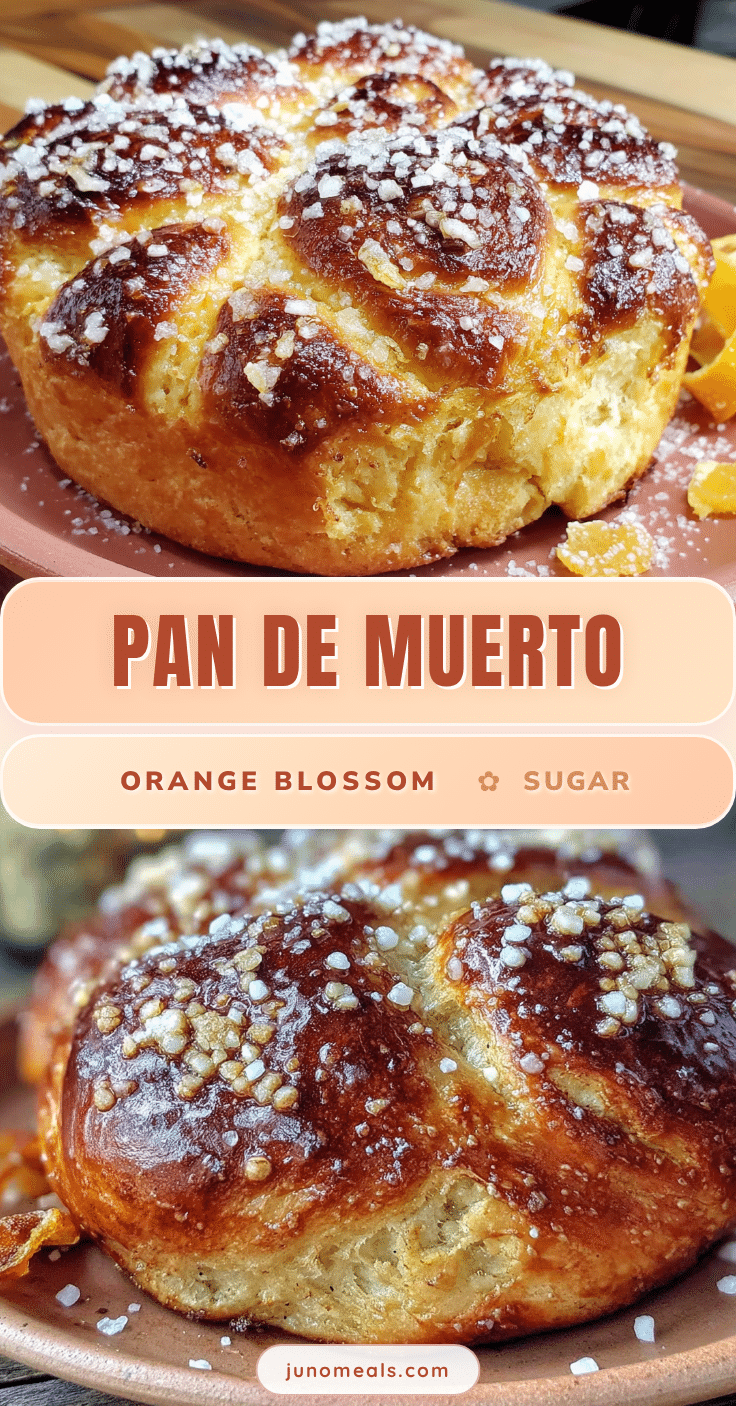
Pan de Muerto Recipe: Homemade Orange Blossom Bread
This Pan de Muerto recipe yields a soft, fragrant bread with a delicate orange blossom flavor and a crunchy sugar topping. It’s a traditional Mexican bread for Día de Muertos, perfect for sharing with loved ones.
- Prep Time: 30 minutes
- Cook Time: 25 minutes
- Total Time: 3 hours
- Yield: 12 servings 1x
- Category: Bread
- Cuisine: Mexican
Ingredients
- 4 cups (500g) all-purpose flour
- 2 ¼ teaspoons (7g) active dry yeast (1 packet)
- ¼ cup (60ml) warm water (105°F-110°F)
- ½ cup (120ml) whole milk, warmed
- ½ cup (100g) granulated sugar
- ½ cup (113g) unsalted butter, softened
- 3 large eggs, room temperature
- 2 tablespoons (30ml) orange blossom water
- 1 tablespoon fresh orange zest (from about 1 large orange)
- 1 teaspoon (6g) fine sea salt
- For the orange blossom sugar topping:
- ¼ cup (50g) granulated sugar
- 1 tablespoon (15ml) orange blossom water
- 2 tablespoons (28g) melted butter
Instructions
- Proof the yeast: In a small bowl, combine warm water, 1 teaspoon of sugar, and yeast. Stir gently and let sit for 5-10 minutes until foamy.
- Mix dry ingredients: In the bowl of a stand mixer, whisk together flour, remaining sugar, salt, and orange zest.
- Combine wet ingredients: Add proofed yeast mixture, warm milk, eggs, orange blossom water, and softened butter to the flour mixture. Use paddle attachment on low speed until a shaggy dough forms.
- Knead the dough: Switch to dough hook and knead on medium-low speed for 8-10 minutes until smooth and elastic. Dough should be soft and slightly tacky.
- First rise: Transfer dough to a lightly greased bowl, turning once to coat. Cover and let rise in a warm, draft-free spot until doubled in size (1 to 1.5 hours).
- Shape the loaves: Punch down dough. Turn onto a lightly floured surface. Divide into two equal pieces. Cut about ¼ from one piece. Roll larger piece into a smooth ball and place on parchment-lined baking sheet.
- Create bones and top knot: Divide smaller piece into 3 sections. Roll each into a 6-inch rope. Cut each rope into 2-inch pieces. For ‘bones,’ roll each piece into a small ball and press indentations on either side. Place four bone pieces around top of loaf in a cross pattern. Roll remaining dough into a small ball and place in center. Repeat with second loaf.
- Second rise: Cover shaped loaves loosely with plastic wrap and let rise until puffy and almost doubled (45 minutes to 1 hour).
- Preheat oven: Set oven to 350°F (175°C). Position rack in center.
- Bake: Bake loaves until deep golden brown and hollow when tapped (20-25 minutes). Internal temperature should reach 190°F (88°C).
- Glaze and sugar: While bread is still warm, brush tops with melted butter, then with orange blossom water. Generously sprinkle orange blossom sugar over top.
- Cool completely: Transfer to wire rack and cool completely before slicing (at least 1 hour).
Notes
Temperature matters: use room temperature ingredients. The windowpane test ensures proper kneading. Don’t overthink shaping; rustic is fine. Watch the oven closely and tent with foil if browning too quickly. Let bread cool properly before slicing to avoid gummy texture.
Nutrition
- Serving Size: 1/12 of a loaf
- Calories: 285
- Sugar: 14
- Sodium: 200
- Fat: 12
- Saturated Fat: 7
- Carbohydrates: 38
- Fiber: 1
- Protein: 6
Keywords: Pan de Muerto, Day of the Dead bread, orange blossom bread, Mexican bread, Día de Muertos recipe