Introduction
My husband claimed he hated deviled eggs for thirty-seven years. Thirty-seven years of passing the platter at every family gathering, every church potluck, every summer barbecue without so much as a sideways glance. Then last October, I found him standing alone in the kitchen at three in the afternoon, eating one of these spider deviled eggs with his bare hands. Didn’t even bother with a plate. Just stood there over the counter, staring at the wall, chewing like he’d been caught stealing cookies at midnight.
I didn’t say anything, of course. I just backed out of the doorway and let him have his moment. But honestly? That’s when I knew this recipe was something special. I mean, if a man who’d spent nearly four decades swearing off deviled eggs couldn’t resist sneaking one before the party even started, then we had a winner on our hands.
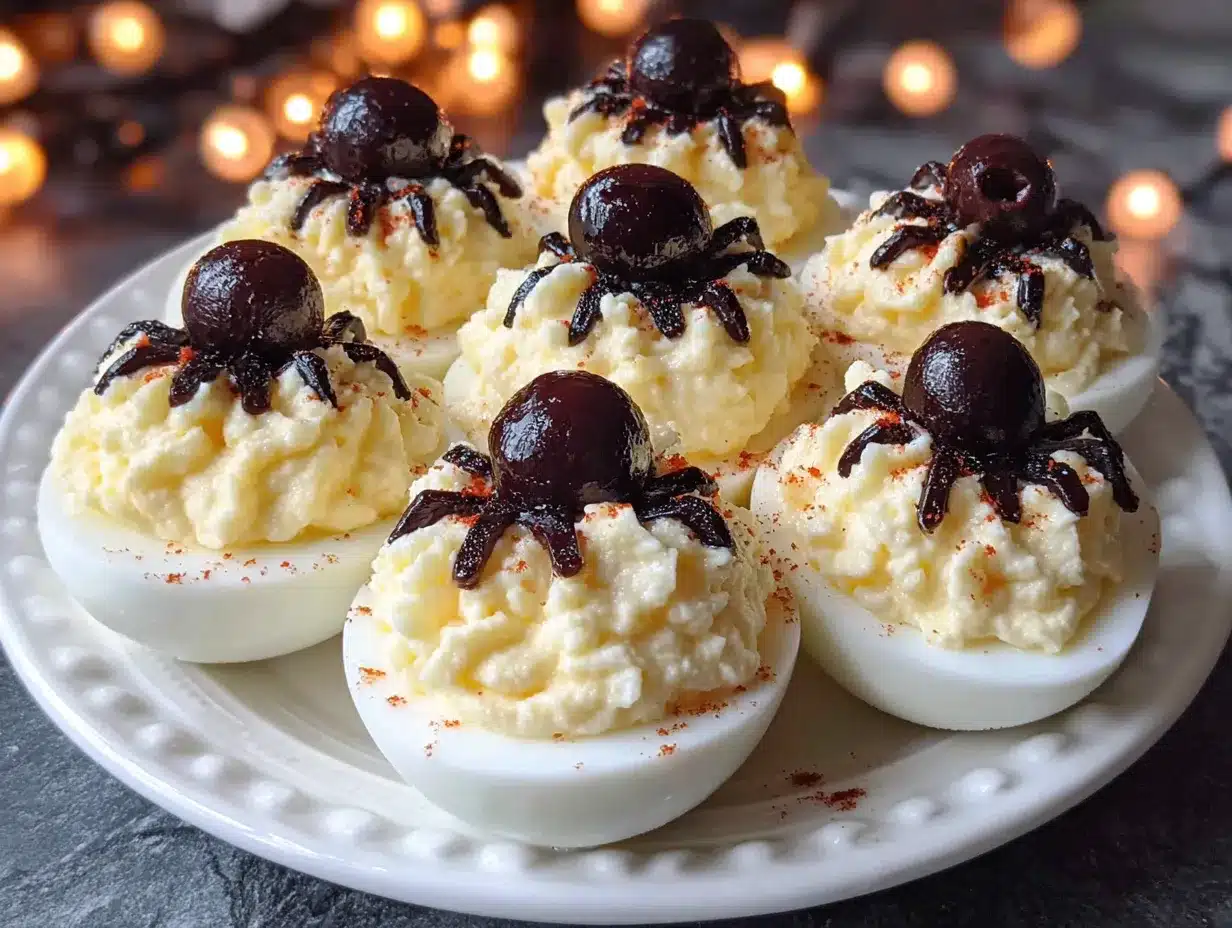
These spider deviled eggs aren’t just cute Halloween party food—though they are adorable in that creepy-crawly way. They’re genuinely, undeniably delicious. The filling is creamy and tangy with just the right amount of mustard bite, and the black olive spiders on top add this briny pop that somehow makes everything better. Maybe you’ve been there—spending hours on a themed dish only to watch it sit untouched while people grab the plain chips instead. That won’t happen here. Trust me on this one.
Why You’ll Love This Recipe
Let me tell you why these spider deviled eggs have become my go-to Halloween party contribution year after year. First off, they’re ridiculously easy to make. Like, embarrassingly easy. You’re basically making regular deviled eggs and then adding a fun garnish. That’s it. But when you walk into a party carrying a platter of these creepy little guys, people act like you’ve been slaving away in the kitchen for days. I’m not complaining about the reputation boost, honestly.
- Quick & Easy : From start to finish, you’re looking at about 30 minutes of active work. Most of that time is just waiting for eggs to boil and cool.
- Simple Ingredients : Eggs, mayo, mustard, vinegar, paprika, and canned black olives. That’s literally everything. No specialty stores required.
- Perfect for Halloween Parties : These things are conversation starters. Kids love them, adults love them, and they fit any Halloween theme from kid-friendly to grown-up spooky.
- Crowd-Pleaser : I’ve brought these to five different Halloween gatherings now, and they disappear every single time. Every time.
- Unbelievably Delicious : The combination of creamy yolk filling with the salty olive legs is honestly addictive. I’m not exaggerating when I say I’ve seen people eat four or five in one sitting.
What makes this recipe different from the dozens of other deviled egg recipes out there? It’s the texture. I’ve perfected the ratio of mayo to mustard so the filling stays fluffy and light instead of turning into that dense, gluey mess you sometimes get. Plus, there’s a tiny splash of pickle juice that brightens everything up without making it taste like pickles. It’s one of those little tricks I stumbled on by accident and now I can’t imagine making them any other way.
This recipe isn’t just good—it’s the kind that makes you close your eyes after the first bite. It’s comfort food dressed up in its Halloween costume, ready to impress your guests without any stress on your part. Perfect for those times when you want to show off a little without actually working that hard.
What Ingredients You Will Need
This recipe uses simple, everyday ingredients to deliver big flavor and serious visual impact. You probably already have most of these in your kitchen right now, which is part of the beauty of these spider deviled eggs.
- 12 large eggs (room temperature if possible—they peel easier)
- 1/3 cup mayonnaise (I prefer Duke’s or Hellmann’s for the right tanginess)
- 1 tablespoon yellow mustard (adds that classic deviled egg zing)
- 1 teaspoon white vinegar (brightens the flavor without overpowering)
- 1 teaspoon pickle juice (trust me on this one—it’s the secret weapon)
- 1/4 teaspoon salt (adjust to taste)
- 1/8 teaspoon black pepper (freshly ground is best)
- Paprika for sprinkling (smoked or sweet, whichever you prefer)
- 1 can (6 ounces) large black olives (you need the big ones for the spider bodies)
- 1 can (4 ounces) sliced black olives (for the spider legs—trust me, slicing your own is tedious)
For the egg situation, I recommend buying an extra dozen just in case some eggs crack during boiling or don’t peel cleanly. Nothing’s worse than getting halfway through and realizing you’re short. I learned that one the hard way, let me tell you.
The mayonnaise brand actually matters more than you’d think. Duke’s has a sharper, tangier flavor that really stands up to the mustard. Hellmann’s is creamier and milder. Either works, but I’m a Duke’s loyalist for deviled eggs specifically. If you’re using a homemade mayo, just make sure it’s thick enough to hold the filling together without getting runny.
For the olives, make sure you get the large whole ones, not the medium or small sizes. You need that big oval shape to look like a proper spider body sitting on top of the egg. The sliced olives for the legs should be the regular sliced kind—not the fancy gourmet ones. You want them thin enough to bend into leg shapes without breaking.
Equipment Needed
You don’t need anything fancy for these spider deviled eggs, which is another reason I love making them for parties. Here’s what you’ll need:
- Large pot for boiling eggs (wide enough that eggs sit in a single layer)
- Medium mixing bowl for the filling
- Fork or potato masher for mashing the yolks
- Piping bag or zip-top bag for filling the eggs (a zip-top bag with the corner snipped off works perfectly)
- Sharp knife for slicing the olive legs (though honestly, the pre-sliced ones save so much time)
- Cutting board
- Serving platter (a dark-colored one makes the spiders pop visually)
If you don’t have a piping bag, don’t worry. I’ve made these using a sandwich bag for years before I finally bought actual piping tips. Just spoon the filling into a sturdy zip-top bag, squeeze it down to one corner, snip off about a quarter inch, and pipe away. Works like a charm every time.
For the serving platter, I like using a black or dark gray one because it makes the white eggs and black olives stand out. But honestly, any platter works. I’ve even arranged them on a cutting board in a pinch and nobody complained.
Preparation Method
Alright, let’s get into the actual making of these spider deviled eggs. I’m going to walk you through every step so you don’t miss anything.
Step 1: Boil the eggs. Place your 12 eggs in a single layer in your pot and cover them with cold water by about an inch. Bring the water to a full rolling boil over high heat. Once it’s boiling hard, cover the pot, turn off the heat completely, and let it sit for exactly 12 minutes. Set a timer—I’m serious. I’ve ruined so many eggs by getting distracted and letting them sit too long. After 12 minutes, drain the hot water and immediately cover the eggs with ice water. Let them sit in the ice bath for at least 10 minutes. This shock treatment makes the shells peel off like a dream.
Step 2: Peel the eggs. Gently tap each egg on the counter to crack the shell all over, then roll it between your palms to loosen things up. Start peeling from the wider end where the air pocket is—that’s usually the easiest spot to get under the shell. Rinse each peeled egg under cool water to remove any tiny shell fragments. Pat them dry with a paper towel.
Step 3: Cut and separate. Using a sharp knife, slice each egg in half lengthwise. Carefully pop out the yolks into your mixing bowl. Arrange the white halves on your serving platter cut-side up. If some of the whites tear a little, don’t panic—just put those ones in the back of the platter where nobody will notice.
Step 4: Make the filling. Add the mayonnaise, yellow mustard, white vinegar, pickle juice, salt, and pepper to the bowl with the yolks. Mash everything together with a fork until it’s completely smooth with no lumps. I usually mash for a good two or three minutes to get that silky texture. Taste it and adjust the seasoning—maybe a pinch more salt, maybe another splash of pickle juice if you want more tang.
Step 5: Fill the eggs. Spoon the yolk mixture into your piping bag or zip-top bag. Snip off the corner and pipe the filling into each egg white half, mounding it up slightly. You want it to look generous and fluffy, not flat and skimpy. If you’re piping, aim for a little swirl on top—it looks fancier and gives the spider something to sit on.
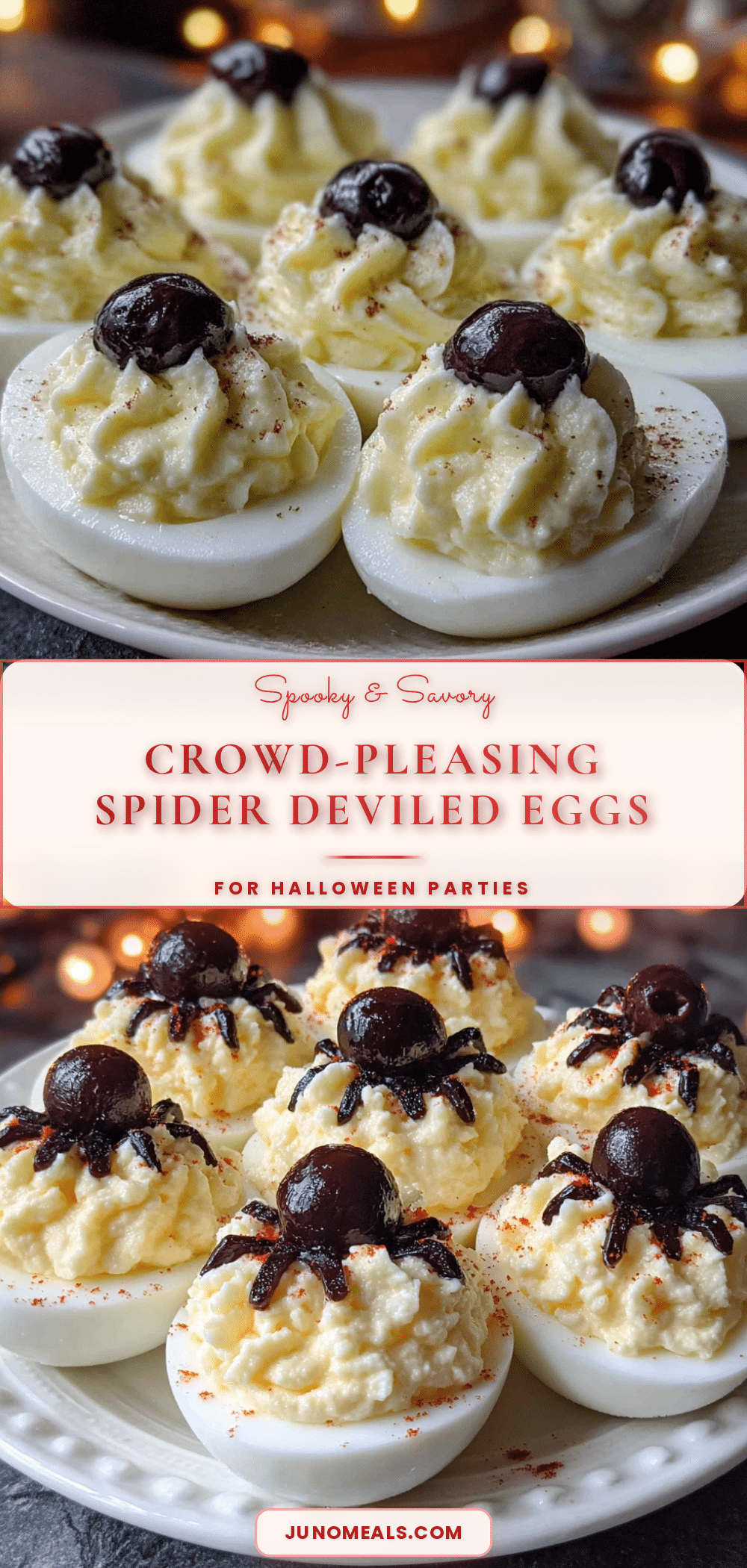
Step 6: Prepare the spiders. Take your large whole olives and slice them in half lengthwise. Each half becomes one spider body. For the legs, you’ll use the sliced olives. Each spider needs 8 legs, so you’ll use 4 sliced olive rounds per spider, cut in half to make 8 little leg pieces. Arrange the leg pieces on top of each deviled egg in a fan pattern—four on each side—then place the olive half on top to hide where the legs meet. Sprinkle a little paprika over everything for that finished look.
Step 7: Chill and serve. Refrigerate the finished spider deviled eggs for at least 30 minutes before serving. This helps the filling firm up and lets the flavors meld together. They’re best served cold, straight from the fridge.
Cooking Tips & Techniques
Let me share some things I’ve learned the hard way so you don’t have to make the same mistakes. First up: egg boiling. The biggest mistake people make is boiling eggs too aggressively. High heat makes the proteins tighten up too fast, which leads to rubbery whites and that unappealing green ring around the yolk. Gentle heat is your friend here. That’s why the off-heat method works so well.
Peeling eggs is another thing that trips people up. If your eggs are fresh, they’re going to be harder to peel. Older eggs actually peel more easily because the pH level changes as they age. So if you’re planning these for a party, buy your eggs a week ahead of time. I keep meaning to tell you that upfront but I always forget until I’m standing at the sink wrestling with a stubborn shell. Also, peeling under running water helps wash away tiny shell fragments and makes the process smoother.
For the filling consistency, you want it to be soft enough to pipe easily but firm enough to hold its shape. If your filling seems too loose, add another yolk or a tiny bit more mayonnaise. If it’s too stiff, add a few drops of pickle juice or vinegar to loosen it up. I’ve had batches go both ways and it’s always fixable.
When you’re arranging the olive legs, work quickly so the olives don’t dry out. I like to prep all the leg pieces first, then do the assembly in an assembly-line fashion. Place four legs on one side, four on the other, then press the spider body down gently to hold everything in place. If the legs aren’t sticking, a tiny dab of mayonnaise on the underside of the olive body acts like glue.
One more thing—make extra filling. I always end up with a little more than I need, and I just eat the leftovers with a spoon while I’m cleaning up. It’s my little chef’s treat.
Variations & Adaptations
The great thing about spider deviled eggs is how easy they are to adapt. Here are some variations I’ve tried over the years:
Spicy Version: Add 1/2 teaspoon of sriracha or hot sauce to the yolk mixture and a pinch of cayenne pepper on top. The heat pairs beautifully with the cool, creamy filling and the briny olives. I made these for a friend’s Halloween party and they were gone in twenty minutes flat.
Bacon Spider Eggs: Crumble crispy bacon over the top before adding the olive spiders. Because everything is better with bacon, right? The smoky, salty crunch adds another layer of texture that’s absolutely irresistible. Just make sure the bacon is finely crumbled so it doesn’t overwhelm the delicate egg flavor.
Avocado Deviled Spiders: Replace half the mayonnaise with mashed ripe avocado. This gives the filling a beautiful green tint and a creamy, rich texture. It’s a great option if you’re trying to make things a little healthier, though honestly, the avocado flavor is mild enough that most people won’t even notice the swap.
Gluten-Free Friendly: These are naturally gluten-free as written, so no adjustments needed there. Just double-check your mustard and mayonnaise labels if you’re serving someone with celiac disease—some brands add wheat-based ingredients.
Dairy-Free Option: These are also naturally dairy-free, which makes them perfect for guests with lactose issues. Just use a vegan mayonnaise if you want to go fully plant-based, though the texture will be slightly different.
I personally love the spicy version best. Something about the heat plus the cold egg plus the salty olive just works on every level. But the classic version is what keeps people coming back year after year, so maybe don’t mess with perfection too much.
Serving & Storage Suggestions
These spider deviled eggs are best served cold, straight from the refrigerator. I like to arrange them on a dark platter with some fake spiderwebs draped around the edges for that extra Halloween touch. A few plastic spiders scattered around the platter adds to the fun without making the eggs themselves inedible—unlike real spiders, which I do not recommend as garnish.
For a Halloween party spread, these pair beautifully with other finger foods like mini sliders, veggie platters, and punch. They’re also great alongside a spooky Halloween punch for a complete themed menu. If you’re doing a potluck, these travel surprisingly well—just keep them refrigerated until you’re ready to leave and transport them on a flat surface so the spiders don’t slide off.
For storage, arrange the finished deviled eggs in a single layer in an airtight container. They’ll keep in the refrigerator for up to two days, though the olives might start to dry out after 24 hours. I honestly wouldn’t recommend making them more than a day ahead because the filling can get a little watery as it sits. The flavor is still fine, but the texture suffers.
If you have leftovers (which honestly never happens at my house), you can store them for another day. The flavors actually develop and get better overnight—the mustard and pickle juice meld together into something even more delicious. Just don’t freeze them. Frozen deviled eggs are a sad, watery mess and I speak from unfortunate experience.
For reheating—well, you don’t reheat deviled eggs. They’re a cold dish through and through. Just pull them out of the fridge about 15 minutes before serving to take the chill off, and they’ll be perfect.
Nutritional Information & Benefits
Each spider deviled egg half contains approximately 70-80 calories, 6 grams of fat, 1 gram of carbohydrates, and 5 grams of protein. The exact numbers depend on your specific ingredients and how generous you are with the filling, but that’s a solid estimate.
Eggs are actually a nutritional powerhouse. They’re packed with high-quality protein, vitamin D, vitamin B12, and choline, which is important for brain health. The yolks contain most of the nutrients, so don’t skip them even if you’re watching your cholesterol. Current research shows that dietary cholesterol from eggs doesn’t impact blood cholesterol the way we once thought.
The olives add healthy monounsaturated fats and a good dose of vitamin E and iron. Plus, they’re low in calories but high in flavor, which makes them a great garnish that adds nutrition without weighing things down.
These are naturally gluten-free and dairy-free, which makes them suitable for most dietary restrictions. If you’re watching your sodium, you can use low-sodium olives and reduce the added salt in the filling. The mustard and pickle juice provide plenty of flavor even with less salt.
I’m not a nutritionist by any stretch, but I feel good about serving these at parties because they’re real food made from real ingredients. No processed stuff, no weird additives. Just eggs, mayo, mustard, and olives. Simple and honest.
Conclusion
These spider deviled eggs have become my signature Halloween dish, and I don’t see that changing anytime soon. They’re fun, they’re delicious, and they’re so easy to make that you’ll wonder why you ever bought store-bought appetizers for your parties. Plus, there’s something deeply satisfying about watching people’s faces light up when they see a platter of creepy little spiders sitting on your snack table.
I hope you’ll give these a try for your next Halloween gathering. Don’t be afraid to make them your own—add some hot sauce if you like spice, throw some bacon on top, or experiment with different olive arrangements. The basic recipe is solid enough to handle whatever twists you want to throw at it.
And if you have a husband who claims to hate deviled eggs? Make these anyway. You might just catch him sneaking one when he thinks nobody’s looking. Trust me, that moment is worth every single egg you peel.
I’d love to hear how your spider deviled eggs turn out! Drop a comment below and let me know if your guests loved them as much as mine do. And if you come up with any fun variations, share those too—I’m always looking for new ideas to try. Happy Halloween, and happy cooking!
Frequently Asked Questions
Can I make spider deviled eggs a day ahead?
You can, but I recommend making them no more than 24 hours in advance. Store them in an airtight container in the refrigerator and add the olive spiders right before serving so they don’t dry out or slide off.
How do I keep the olive spiders from falling off?
Use a tiny dab of the yolk filling as “glue” on the underside of the olive body before placing it on the egg. The filling acts like edible adhesive and helps the spider stay put during transport and serving.
My eggs are hard to peel—what am I doing wrong?
Use older eggs (buy them a week ahead), cool them immediately in an ice bath after boiling, and peel them under running water. Fresh eggs are notoriously difficult to peel, so planning ahead makes a huge difference.
Can I use a different type of olive for the spiders?
Large black olives work best because they’re big enough to look like spider bodies and have a mild flavor that doesn’t overpower the eggs. Green olives are too small and too briny—they’ll throw off the flavor balance.
How many spider deviled eggs should I make per person?
For a party where there are other appetizers, plan on 2-3 deviled egg halves per person. If these are the main appetizer or you know your crowd loves deviled eggs, bump that up to 4-5 per person. I always make extra because they disappear fast.
Pin This Recipe!
Best Spider Deviled Eggs Recipe for Halloween
These spider deviled eggs are a fun and delicious Halloween party appetizer. Creamy, tangy deviled eggs topped with black olive spiders that are sure to be a hit with kids and adults alike.
- Prep Time: 30 minutes
- Cook Time: 12 minutes
- Total Time: 42 minutes
- Yield: 24 deviled egg halves 1x
- Category: Appetizer
- Cuisine: American
Ingredients
- 12 large eggs (room temperature if possible)
- 1/3 cup mayonnaise (preferably Duke’s or Hellmann’s)
- 1 tablespoon yellow mustard
- 1 teaspoon white vinegar
- 1 teaspoon pickle juice
- 1/4 teaspoon salt
- 1/8 teaspoon black pepper (freshly ground)
- Paprika for sprinkling (smoked or sweet)
- 1 can (6 ounces) large black olives
- 1 can (4 ounces) sliced black olives
Instructions
- Boil the eggs: Place eggs in a single layer in a pot, cover with cold water by 1 inch. Bring to a full rolling boil over high heat. Cover, turn off heat, and let sit for exactly 12 minutes. Drain and immediately cover with ice water. Let sit for at least 10 minutes.
- Peel the eggs: Gently tap each egg on the counter to crack the shell, roll between palms, and peel starting from the wider end. Rinse under cool water and pat dry.
- Cut and separate: Slice each egg in half lengthwise. Pop out yolks into a mixing bowl. Arrange white halves on a serving platter cut-side up.
- Make the filling: Add mayonnaise, yellow mustard, white vinegar, pickle juice, salt, and pepper to the yolks. Mash with a fork until completely smooth. Taste and adjust seasoning.
- Fill the eggs: Spoon filling into a piping bag or zip-top bag. Snip off the corner and pipe filling into each egg white half, mounding slightly.
- Prepare the spiders: Slice large whole olives in half lengthwise for bodies. For legs, use sliced olives—each spider needs 8 legs (4 sliced rounds cut in half). Arrange leg pieces on each deviled egg in a fan pattern (4 per side), then place olive half on top. Sprinkle with paprika.
- Chill and serve: Refrigerate for at least 30 minutes before serving. Serve cold.
Notes
Use older eggs (buy a week ahead) for easier peeling. For the olive spiders, use a tiny dab of yolk filling as ‘glue’ to keep them in place. Make no more than 24 hours ahead; add olive spiders just before serving. For a spicy version, add 1/2 teaspoon sriracha or hot sauce to the filling.
Nutrition
- Serving Size: 1 deviled egg half
- Calories: 75
- Sodium: 180
- Fat: 6
- Saturated Fat: 1.5
- Carbohydrates: 1
- Protein: 5
Keywords: spider deviled eggs, Halloween appetizer, deviled eggs, Halloween party food, creepy crawly eggs